
While the patient gets a single dose of exposure – and that’s bad enough – physicians and their staff are exposed to radiation from every single procedure. Despite protective gear, this exposure adds up over time and has been of increasing concern for physicians who perform these types of procedures. — Dr. Tahara
Near-Zero™ Ultrasound Guided Peripheral Vascular Procedures
Everything you need to know about Near-Zero™.
What is Near-Zero™?
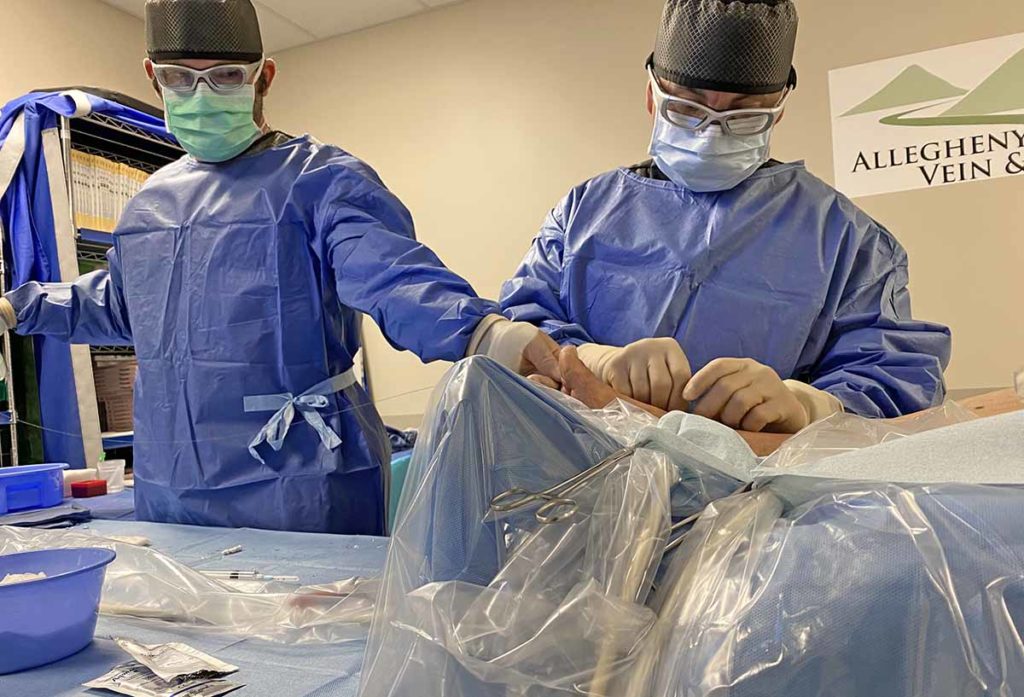
Near-Zero™ is the trademarked name for a procedure developed at Allegheny Vein and Vascular by Dr. Robert Tahara. Essentially, Near-Zero is a way of combining a pedal (foot) access with ultrasound guidance to perform atherectomy, angioplasty and stenting procedures inside the leg arteries. Dr. Tahara developed Near-Zero with an eye towards decreasing/eliminating many of the known risks associated with traditional endovascular procedures that involve radiation, use of contrast, and use of the larger groin vessels for access.
WHAT ARE THE BENEFITS OF NEAR-ZERO?
Near-Zero offers significant advantages over traditional peripheral vascular techniques. In fact, Dr. Tahara uses the moniker of “Near-Zero™” to describe this endovascular technique specifically because the patient has near-zero radiation exposure, near-zero contrast exposure, near-zero down time, and near zero-complications. The same cannot be said for traditional methods. Learn more below about the breakthrough Near-Zero endovascular technique and the significant benefits it offers to patients of Allegheny Vein and Vascular.
1. NEAR-ZERO RADIATION
How everyone else does it: Traditional endovascular methods use flouroscopy to visualize vessels during a procedure. Since flouroscopy can be thought of as live, continuous x-rays, the exposure to radiation can be significant. Dr. Tahara explains the problem…
How we do it: At Allegheny Vein and Vascular, we use ultrasound guidance as our primary mode of visualization during most of our minimally-invasive arterial procedures. We do utilize traditional fluoroscopy when needed, but we’ve been able to decrease radiation exposures to patients and staff by up to 90% on average. However, a significant reduction in radiation exposure is not the only benefit to employing ultrasound guidance.
Dr. Tahara explains how the Near-Zero technique goes beyond just solving the radiation problem…
Since images produced by fluoroscopic x-rays are essentially just two dimensional shadows, we’ve found that many significant lesions are missed and potentially left untreated (or under treated) when using this modality. On the other hand, duplex ultrasound increases our diagnostic capabilities during the procedure. By interrogating diseased vessels with B-mode, pulse wave doppler, and color flow imaging, we can locate and treat stenoses as well as re-evaluate the vessel for treatment effectiveness and immediately follow up with further treatment if necessary. — Dr. Tahara
2. NEAR-ZERO CONTRAST
Contrast is an injectable radio-opaque dye that is used in conjunction with fluoroscopy to delineate vessel anatomy and plaque burden, among other things. Contrast is considered “nephrotoxic”, which means that it is not good for the kidneys (whose job it is to filter the blood). For patients with low creatinine levels and poor kidney function, too much contrast can kill their kidneys and result in the need for dialysis. Dr. Tahara goes on to explain why avoiding contrast is often critical…
While there are medications that can be given prior to a procedure to help buffer the kidneys from contrast exposure, some patients simply cannot handle any contrast exposure. Also, a significant minority of patients have an allergy to contrast and need an alternative. The beauty of Near-Zero and employing ultrasound guidance is that there is no radiation required and no contrast required. — Dr. Tahara
3. NEAR-ZERO DOWN TIME
When the larger groin vessels are used for access, patients are typically required to lay flat on a recovery bed for 2-5 hours — and possibly overnight — if the procedure is performed in a hospital setting. However, performing the procedure in an outpatient setting like Allegheny Vein and Vascular can be a game changer. Dr. Tahara typically uses the small vessels of the ankle or foot for access and therefore our patients usually have only about an hour of down time after a procedure. At that point they can get up, ambulate, and be discharged.
Another key benefit to Allegheny Vein and Vascular’s Near-Zero procedure is that patients do not have to lie perfectly flat after the procedure is over. Dr. Tahara goes on to explains how patient comfort during the post-op recovery period can make a big difference…
Using the pedal access site (instead of the larger groin vessels) means that we can raise the head of the bed as soon as the procedure is finished. This may not seem like a big deal, but for many patients who experience back problems I can assure you that it is a HUGE relief to them.— Dr. Tahara
4. NEAR-ZERO COMPLICATIONS
Traditional endovascular techniques can create several possible complications. For instance, when the larger groin vessels (often 1.0 cm or larger in diameter) are used for access, there are several potential complications such as closure device failure, vessels tears, and psuedoaneurysm formation. Fortunately, these are all fairly uncommon complications. However, when they do occur it can necessitate a trip to surgery for repair. Additionally, if any of the aforementioned complications are present and not discovered in time it can have devastating consequences — including death.
Dr. Tahara explains how Near-Zero reduces or eliminates some of the complications associated with traditional endovascular repairs…
Markedly decreased complication rates are another hallmark of our Near-Zero technique because we use the smaller vessels of the foot and ankle for access. Small vessels (usually around 0.30cm in diameter) do not even require closure devices. Also, bleeding problems simply aren’t an issue because that access site can be easily controlled. — Dr. Tahara
WHAT YOU NEED TO KNOW PRIOR TO NEAR-ZERO
The Near-Zero procedure is performed in an outpatient setting like Allegheny Vein and Vascular. Dr. Tahara will perform a comprehensive pre-op evaluation and provide you with detailed instructions about how to prepare for the procedure. Dr. Tahara carefully explores your medical history during pre-op evaluation, including recent illnesses, existing medical conditions, and any allergies you have or medications you’re taking. He will also carefully explain how you should manage your regular medications, food, and drink just prior to the procedure. As a typical example, you may be told not to eat or drink anything several hours before arrival. You may also be asked to wear loose and comfortable clothing and refrain from wearing jewelry.
WHAT TO EXPECT AFTER YOUR PROCEDURE
The Allegheny Vein and Vascular nursing staff will call you about 24 hours after your procedure to check up on you. Typically, the patient will also come in for a followup visit with Dr. Tahara about a week after the procedure is completed. From there on out, you will be scheduled for office visits and duplex ultrasound appointments as necessary.
IMPORTANT: It is vital that patients keep their followup appointments. The reason for this is that vascular disease is not something that just goes away. It is a process that continues, even after any necessary procedures have been performed. Regular monitoring of your condition will be required in order to help you realize your best possible outcome for the long term.
ALL THINGS VASCULAR
Copyright © 2022 - Allegheny Vein & Vascular. All rights reserved.