Chronic Venous Insufficiency (CVI)

Everything you need to know about Chronic Venous Insufficiency (CVI).
Chronic Venous Insufficiency (CVI)

Chronic Venous Insufficiency (CVI) is a condition that is far more prevalent in our society than most people realize, with up to 40% of Americans having it. CVI is more common with advanced age and with women who have had multiple pregnancies, but the overall numbers are still staggering. Sadly, most individuals with CVI do not seek treatment for it or even know that preventative measures can be taken to avoid it or slow its progression. Many just assume that there’s nothing to be done for CVI and just live with the telltale symptoms – spider veins, skin discoloration below the knee, bulging veins, leg swelling, tired legs, leg cramping at night, restless legs, or ulcers at the inner ankle.  At Allegheny Vein and Vascular, we want you to know that you have treatment options.  You don’t have to just live with it!

Okay, so A lot of People have CVI… but WHAT is it?

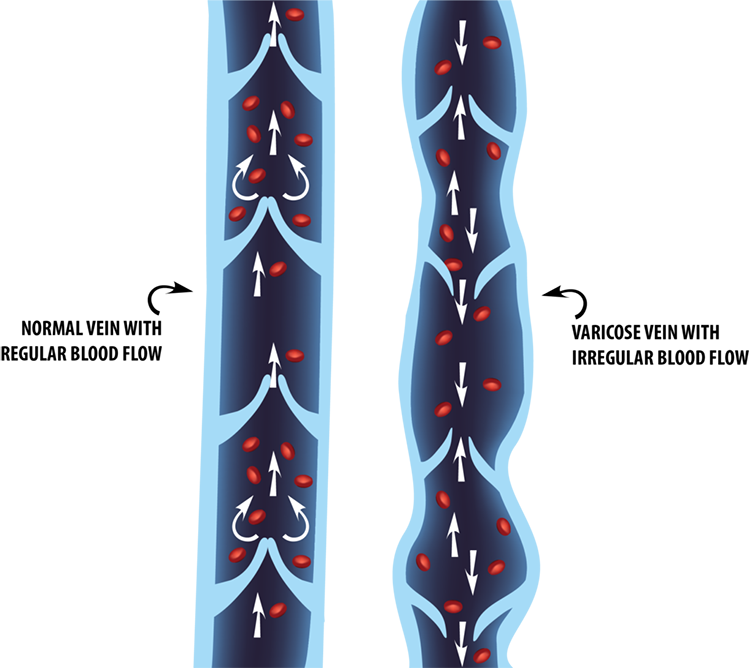
In order to understand CVI, you will need to understand how your veins work – or don’t work – as the case may be. Chronic Venous Insufficiency is a progressive disease whereby the tiny valves inside of your veins begin to fail. As CVI worsens over time and more valves fail, your veins function suboptimally. In fact, your entire venous system as a whole functions less efficiently. CVI affects both the superficial and deep venous systems and leads to a wide range of symptoms, depending on the severity of the disease.

Now before your eyes start to glaze over, know that this is actually pretty interesting stuff. Understanding CVI on a deeper level is critical, because there are things that can be done to avoid it or significantly slow it down. Proper and timely treatment will only lead to a better quality of life for you. So, join us for a few minutes — put your “Vascular Nerd” hat on — and find out just how amazing your veins really are!

Arteries have the heart for an engine, but what about the veins?

Your heart pumps oxygenated and nutrient rich blood via your arteries throughout your entire body – all the way to the tips of your fingers and toes. Your veins have the important job of returning that blood – now deoxygenated and containing cellular waste – back up your heart and lungs. In other words, your arteries are the supply system and your veins are the return system. Together they make a complete circulatory system that goes round and round.

At any given time, the typical adult will have around 1.5 gallons (about 10 units) of blood circulating throughout their body – even more in pregnant women, who can have up to 50% more blood added to their circulatory system during pregnancy.

Now, the fingers and toes don’t have 20 little hearts to pump the return supply of blood through the veins and back to the heart and lungs. Instead, your veins use a combination of breathing and muscle pumps to propel the blood upward and ‘one-stop’ valves that open to let blood through and close to prevent the blood from flowing backwards.

Gravity is no friend to your veins

The venous return system is actually quite an elegant and simple solution to a difficult problem. However, our legs provide the greatest challenge to this otherwise simple solution.

Think of it this way. The blood contained in your leg veins is essentially a column of blood that has weight and is therefore subject to gravitational forces. Gravity always wants to pull the blood back towards your feet. Your venous return system must overcome this gravitational pull and efficiently move blood up and out of the leg. This is no small feat!

Now you’re talking Physics! Can’t you just Give me an Example?

Okay, in a nutshell, every time you take a step the muscles in your calf contract (this is called the calf muscle pump) which squeezes your veins. The valves open during muscle contraction, allowing the deoxygenated blood to be propelled upwards against gravity. As the muscles stop squeezing, all those tiny valves inside your veins snap shut to prevent gravity from dragging the blood backwards.

Breathing also helps move blood in your veins. As the diaphragm moves up and down with each breath, it creates a pressure gradient which pulls and pushes blood through your veins. When any part of this system fails – typically, when the valves no longer function properly – blood is not returned as smoothly or efficiently as it should be. So, instead of the blood successfully getting up and out of the leg, gravity pulls the blood down to the lower calf and ankle causing it to pool. This essentially creates the condition we now know understand to be chronic venous insufficiency (CVI).

Why Do Valves Fail?

There are a number of contributing factors that can lead to valve failure and subsequently to Chronic Venous Insufficiency (CVI), including:

  • Hereditary factors
  • Jobs with long periods of standing or sitting
  • May-Thurner Syndrome
  • Pregnancy, particularly multiple pregnancies
  • Congestive Heart Failure

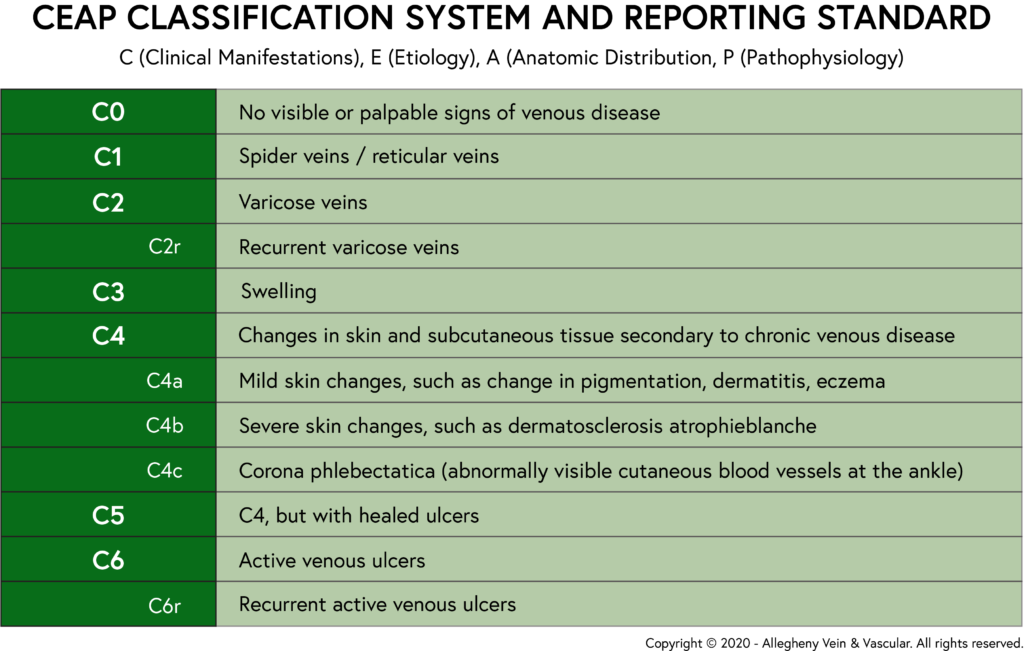
CEAP Classification System

A number of years ago, Vascular Surgeons created a classification system (CEAP) to help their patients and themselves better understand where in patients fall the venous disease progression path.

Where do YOU fit in the chart?

What ``C`` are you?

Are you a C1 with spider veins, or perhaps a C6 with an active ulcer? Or maybe you are somewhere in between, like a C3 with swelling or C4 with skin color changes. Regardless of where you fit in this chart, getting a CEAP classification tells you and your doctor where you stand in the disease progression of Chronic Venous Insufficiency.

The good news!

There are several ways you can slow down, stabilize, or even improved your CEAP classification. It is important to note though that CVI cannot be cured – but it can be treated, and here’s how:

ALL THINGS VASCULAR

A great place to learn about all things vascular.

Take time to learn about the vascular system and how it functions.

Learn about venous and arterial vascular conditions that affect the body.

Explore treatments & procedures offered through Allegheny Vein & Vascular.

Learn about the examinations and testing protocols vascular patients receive.