
May-Thurner Syndrome
What you need to know about May-Thurner Syndrome.
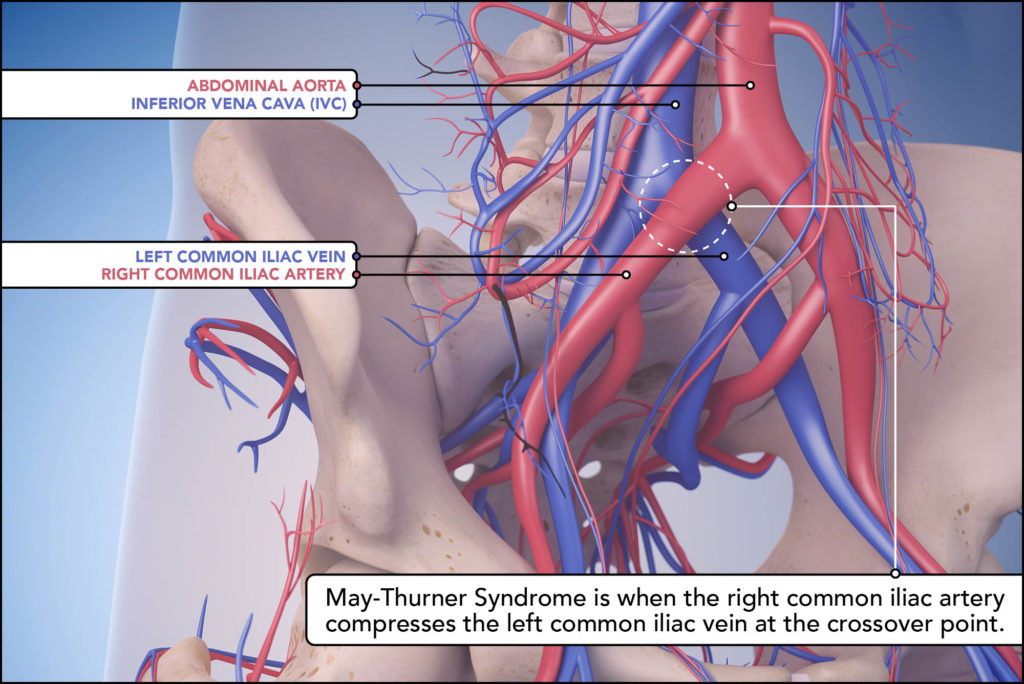
WHAT IS MAY-THURNER SYNDROME?
- Right Iliac Artery — carries blood to your right leg.
- Left Iliac Vein — brings blood out of your left leg toward your heart.
May-Thurner syndrome happens when the right iliac artery puts pressure on the left iliac vein as they cross over each other inside the pelvis. The pressure restricts blood flow through the left iliac vein. This is problematic for a number of reasons, and may lead to the development of a deep vein thrombosis (DVT) in the left leg. A DVT is a serious blood clot formation in the vein that restricts the flow of blood as it moves through the leg. This type of blood clot can break free and lodge itself in the lung, creating a potentially life-threatening pulmonary embolism.
May-Thurner syndrome is not genetically passed down. The crossover of the right iliac artery and the left iliac vein is normal. However, if the right iliac artery presses the left iliac vein against the spine then the additional pressure can narrow the opening and scars may develop inside the vein.
SYMPTOMS OF MAY-THURNER SYNDROME / DVT
The symptoms associated with deep vein thrombosis (DVT) include:
- Skin color changes — may look reddish or purple
- Heaviness, tightness, tenderness, throbbing or cramping in the left leg
- Skin that’s warm to the touch
- Swelling in the left leg, or veins that appear bigger than usual
If the DVT breaks off and moves to your lungs, you may experience the following symptoms of pulmonary embolism:
- Chest pain when breathing in deeply
- Coughing up blood from the lungs
- Rapid heart rate and/or passing out
- Shortness of breath or difficulty breathing
RISK FACTORS FOR MAY-THURNER SYNDROME
- Gender — females are more likely than males
- Scoliosis increases the likelihood
- If you’ve recently given birth or have more than one child
- If you take birth control pills
- Conditions that increases blood clotting
- Dehydration can also increase the risk
DIAGNOSING MAY THURNER SYNDROME
Imaging tests used to help with diagnosis of May-Thurner syndrome and DVT include:
- MRI
- CT Scan
- Duplex Ultrasound
- Venogram with contrast
TREATING MAY THURNER SYNDROME
Treating May-Thurner syndrome can be done in a number of ways:
- Anticoagulants prevent the propagation of clots (may be prescribed for up to 6 months).
- Thrombolytic medications can be used to dissolve large, fresh clots that are no more than 2 weeks old (not preferred due to increased risk of sudden bleeding).
- Bypass surgery to reroute and restore normal blood flow around the ‘squeezed’ left iliac vein.
- Surgery to reposition the right iliac artery may be performed.
- A tissue sling can be used to cushion the area between the right iliac artery and left iliac vein.
- An inferior vena cava (IVC) filter can be used in certain limited circumstances. This cone-shaped device can be used to catch blood clots before they move to the lungs or heart. At Allegheny Vein & Vascular we use retrievable IVC filters that can be removed up to 6 weeks after their initial placement, eliminating the problems associated with most permanent IVC filters.
- Surgical Thrombectomy — not used often, but this procedure is used to remove larger clots, or any clot that are causes severe damage to the tissue.