
Peripheral Aneurysms
Here we discuss causes, risks, and complications of peripheral aneurysms.
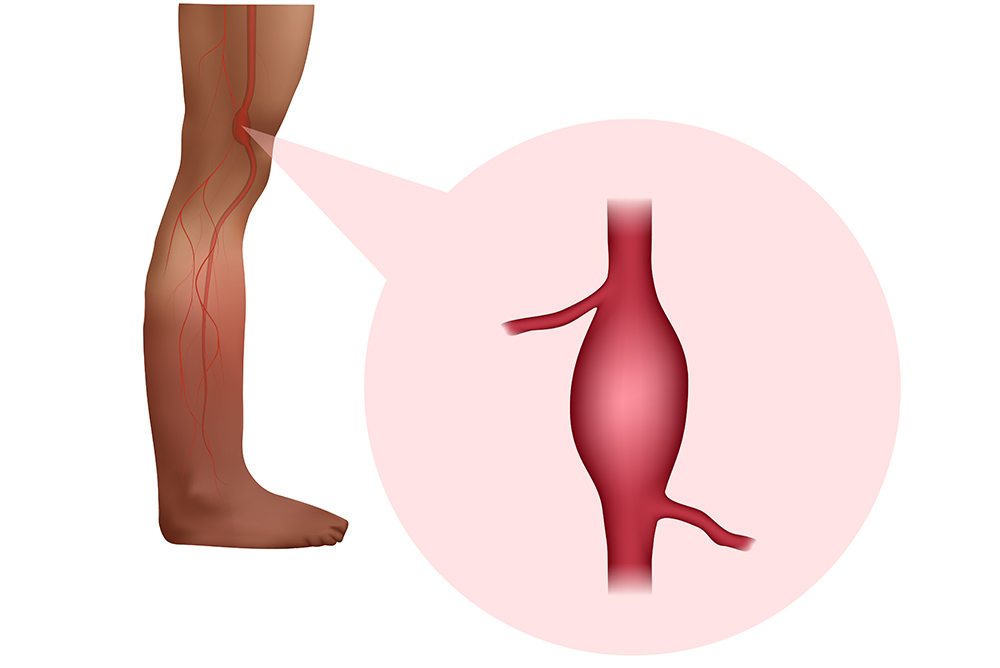
WHAT IS A PERIPHERAL ARTERIAL ANEURYSM?
In general, aneurysms are weakened and/or enlarged areas that occur along arteries. The most common aneurysms are located in our body’s largest blood vessel, the aorta. However, aneurysms can manifest in any artery found in the body and there are different types.
In general, aneurysms that occur in any artery other than your aorta are referred to as peripheral aneurysms.
Peripheral aneurysms also occur in these locations:
- Popliteal arteries — continuations of the femoral arteries and located behind the knees. Very common location for aneurysms – in fact, 85% of peripheral aneurysms are located in the popliteal artery.
- Femoral arteries — located in the groin and supply blood to thighs and legs.
- Subclavian and Axillary arteries — supply blood to the upper extremities and into the shoulders.
- Carotid arteries — located in the neck.
- Brachial, Radial and Ulnar arteries — these arteries supply blood down the length of your arms and into the hands.
PERIPHERAL ANEURYSM CAUSES & RISK FACTORS
The specific causes for peripheral aneurysms is not yet certain. However, research has indicated that atherosclerosis is integrally involved in the manifestation of peripheral aneurysms.
Peripheral aneurysms are relatively common in both men and women but certain factors may increase your risk.
Common risk factors for peripheral aneurysms:
- If you have an established family history of aneurysms.
- If you have experienced aneurysm previously you are at higher risk for recurrence.
- If you are a current smoker or have a history of smoking the risk is much greater.
- High blood pressure, high cholesterol, or obesity all increase risk.
- If there are structural problems of the blood vessel walls such as connective tissue disorders.
- Age — the risk increases the older you get. Most peripheral aneurysms are diagnosed in people 60 and older.
- Gender — abdominal aortic aneurysms and aneurysms of the leg arteries occur in males with greater frequency.
PERIPHERAL ANEURYSM COMPLICATIONS
The risk for rupture is lower with peripheral aneurysms but they can cause other problems. Thrombus (blood clots) can accumulate inside the aneurysm sac, creating a narrowing that inhibits blood flow to the lower legs and feet which can cause claudication. Sometimes, the thrombus becomes an embolic source tossing blood clots to the small arteries of the feet. This can cause tissue loss.
In some instances, peripheral aneurysms can also increase pressure on any nerves and veins located in the same area. This can lead to pain, loss of sensation, and swelling without appropriate treatment.
ALL THINGS VASCULAR

Copyright © 2022 - Allegheny Vein & Vascular. All rights reserved.