
Renovascular Conditions

Learn about vascular conditions affecting the kidneys.
ABOUT RENOVASCULAR CONDITIONS

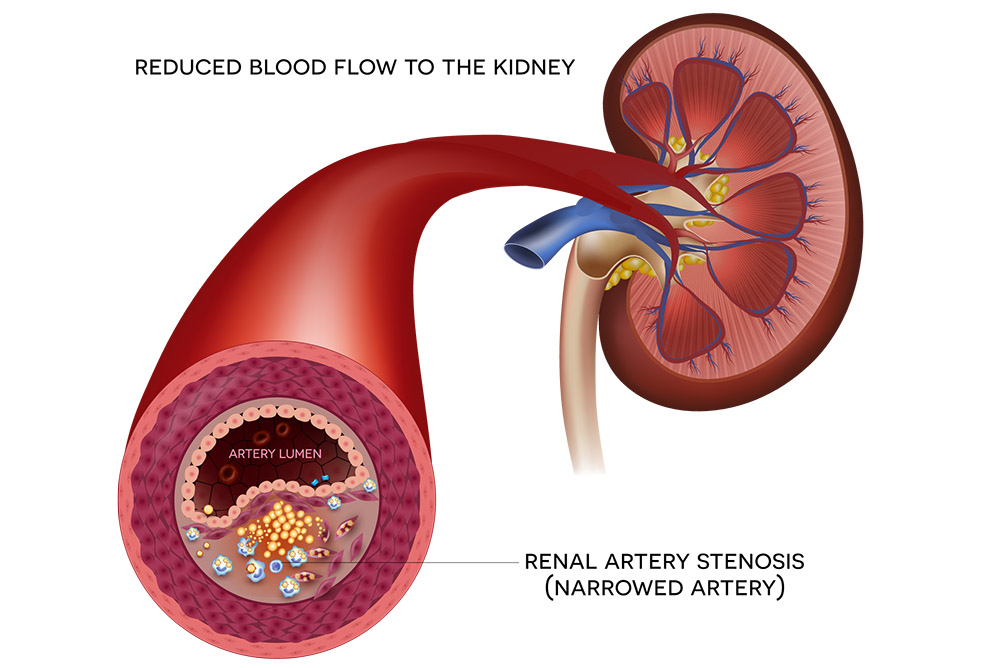
While there are many causes for kidney dysfunction, renovascular conditions in particular can affect kidney health by decreasing blood flow to the kidneys and causing them to shrink. The renal arteries branch off of the abdominal aorta just below the breastbone.  These arteries are responsible for filtering the blood and removing waste.  Waste products are excreted from the body as urine.

Like all other arteries, the renal arteries are susceptible to blockage (renal artery stenosis). When the renal arteries become hardened (atherosclerosis) and plaque builds up on the interior wall it is known as renal artery disease.

Several diseases are known to affect the renal arteries, the most common of which is atherosclerosis. A few less common diseases are also know to affect renal artery function, which include vasculitis (arterial inflammation), renal artery aneurysms, and fibromuscular dysplasia (FMD).

RISK FACTORS FOR RENAL ARTERY DISEASE

There are a number of risk factors for developing a renovascular condition.  Without a doubt, the risk is much higher for smokers, diabetics, individuals over 50, and anyone who has a family history of coronary artery disease or peripheral arterial disease. Patients with high blood pressure/cholesterol or high triglycerides are also at greater risk for developing renal artery stenosis or another disease affecting the arteries. However, atherosclerosis is usually found to be the underlying cause for renal artery disease.

SYMPTOMS OF RENAL ARTERY DISEASE

Having recalcitrant high blood pressure that does not respond to medication is often a primary symptom of renal artery disease. Additionally, fluid retention, foamy or dark colored urine, fatigue, and congestive heart failure are possible symptoms. However, there are also cases where renal artery disease is present but there are few or no symptoms. Even in the absence of symptoms, know that renal artery disease must be taken very seriously as it can eventually result in kidney failure.

RENAL ARTERY DISEASE DIAGNOSIS

There are a handful of exams and tests that may be used to diagnose your condition, but it must begin with a physical evaluation. If you have a family history of coronary artery disease or peripheral arterial disease and the risk factors for renal artery disease apply to you, the first priority should be for you to get evaluated by a vascular surgeon or vascular specialist such as Dr. Tahara at Allegheny Vein & Vascular.

Learn more about the methods used at AVV to diagnose renal artery disease:

  • Evaluation
  • Serum creatinine testing
  • Duplex ultrasound
  • CT angiogram (CTA)
  • Magnetic Resonance Angiogram (MRA)
  • Angiogram

RENAL ARTERY DISEASE TREATMENT

If your condition does require intervention, know that it may be possible to use minimally-invasive techniques to treat your condition.

Learn more about the options for renal artery disease treatment:

  • Lifestyle changes
  • Medical therapy
  • Angioplasty & Stenting
  • Renal bypass surgery

RENAL HEALTH: ADDITIONAL RESOURCES

Below is a list of additional resources for you to learn more about kidney health:

NOTE: the resources listed above are meant to educate you on kidney health, in general (as opposed to the renal arteries).
ALL THINGS VASCULAR

A great place to learn about all things vascular.

Take time to learn about the vascular system and how it functions.

Learn about venous and arterial vascular conditions that affect the body.

Explore treatments & procedures offered through Allegheny Vein & Vascular.

Learn about the examinations and testing protocols vascular patients receive.