
Superficial Thrombophlebitis
Learn about types, causes, and symptoms of superficial thrombophlebitis.
WHAT IS SUPERFICIAL THROMBOPHLEBITIS?
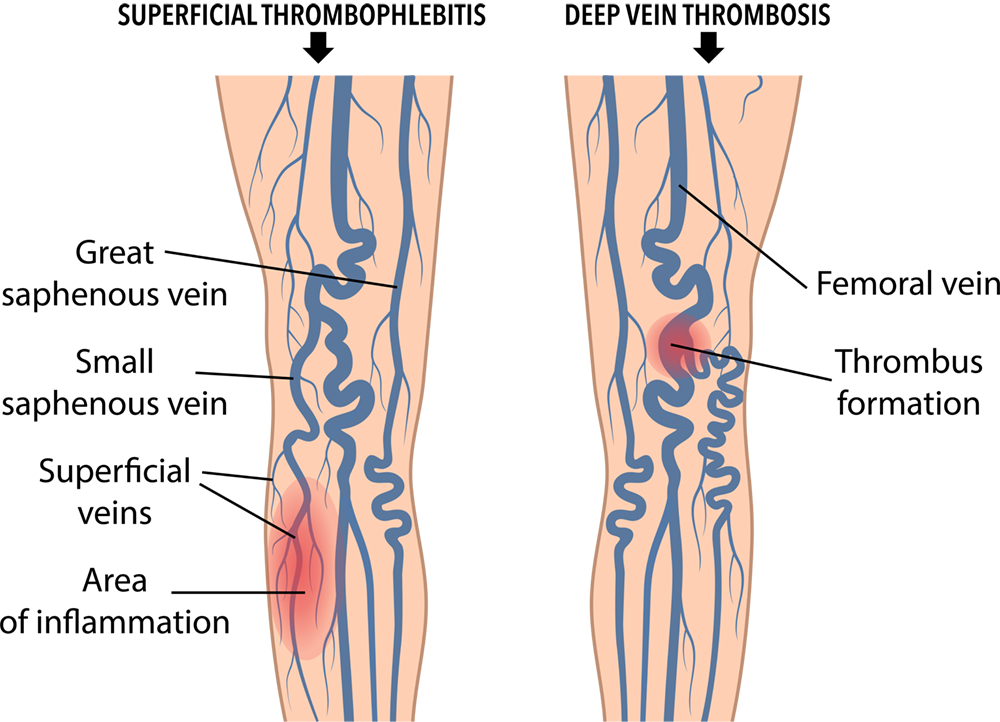
Let us define superficial thrombophlebitis in steps and begin by defining a condition known as phlebitis. The term phlebitis is used to describe veins that are painful, red and inflamed. Now, if a patient has thrombophlebitis it means that there is a blood clot inside the vein that causes pain and swelling. Finally, if the vein that has a clot is located just underneath the skin (i.e., part of the superficial venous system) we call it superficial thrombophlebitis.
Being close to the surface of the skin, this type of blood clot usually won’t migrate to the lungs unless it dislodges and reaches veins deeper in the body (deep vein thrombosis (DVT)). However, superficial thrombophlebitis is still painful and may require treatment.
There are three general causes for superficial thrombophlebitis:
- Trauma to the vessel (i.e., intravenous (IV) line)
- Venous stasis (i.e., long plane flights or car rides)
- Hypercoagulable state (i.e., birth control pills, thrombophilic or a hypercoagulable trait such as Leiden Factor V)
In some cases, however, the direct cause for this type of clot may not be readily apparent.
SYMPTOMS OF SUPERFICIAL THROMBOPHLEBITIS
There are a number of common symptoms associated with superficial thrombophlebitis, including:
- Leg and or arm swelling, often occurring suddenly
- Pain and tenderness in the area of the blood clot
- Area around the clot feels warm to the touch
- The skin around the clot is often red or discolored
SUPERFICIAL THROMBOPHLEBITIS: RISK FACTORS
There are a number of risk factors which may contribute to the development of superficial thrombophlebitis, including:
- A genetic predisposition or family history of developing blood clots
- Having cancer or receiving cancer treatments like chemotherapy
- Restricted blood flow from trauma, a previous surgery, or inactivity
- Being pregnant, or directly following pregnancy
- Individuals over the age of 40 are at higher risk
- Obesity/overweight
- Birth control pills, hormone therapy, and treatments for postmenopausal symptoms may increase risk
- Central venous catheter (CVC) or pacemaker placement may increase risk
NOTE: many of the risk factors for superficial thrombophlebitis are the same ones we would identify for deep vein thrombosis (DVT).
DIAGNOSING SUPERFICIAL THROMBOPHLEBITIS
Whenever superficial thrombophlebitis is suspected, it is highly recommended that a vascular surgeon or vascular specialist be involved in the diagnosis. It is often the case that a doctor suspects superficial thrombophlebitis based on an initial physical examination. However, a duplex ultrasound should be used to confirm the diagnosis. Without ultrasound, a healthcare provider could misdiagnose the condition as a muscle-related problem. Getting an ultrasound has the added benefit of being able to detect deep vein thrombosis. As many as 20% of patients with superficial thrombophlebitis are also found to have a deep vein thrombosis (DVT) condition.
TREATING SUPERFICIAL THROMBOPHLEBITIS
Treating superficial thrombophlebitis can be handled in a number of ways, depending on the symptoms and severity of the condition.
Depending on severity, superficial thrombophlebitis may be treated in the following ways:
- The use of compression stockings
- Non-steroidal anti-inflammatory pain medications (NSAIDs)
- Elevating the legs
- Increased activity as prescribed by your doctor
- Anticoagulants, whenever there is a greater risk for developing DVT
- Surgical procedures like sclerotherapy and endovenous ablation
ALL THINGS VASCULAR
Copyright © 2022 - Allegheny Vein & Vascular. All rights reserved.