
Stents and Stent Grafts

Everything you need to know about stents and stent grafts.

WHAT ARE STENTS AND STENT GRAFTS?

A stent is basically a wire mesh tube that is either woven metal or laser-cut from a solid metal tube. They can either be bare metal stents, drug-alluding stents, or a covered stent graft. All stents are permanent implants designed to be used for specific purposes in specific areas of the body. They are most commonly used to prop open plaque-laden arteries and repair arterial aneurysms, although they may also be used in veins.

WHERE ARE STENTS AND STENT GRAFTS USED?

Here are some examples of where stents and stent grafts are commonly placed in the body:

  • Covered Stent Grafts — endovascular aortic aneurysm repair (EVAR)
  • Bare Metal Stents — iliac vein stenting for treating May-Thurner Syndrome
  • Drug-alluding Stents — for treatment of conditions associated with peripheral artery disease (PAD) such as occluded or narrowed leg arteries

HOW ARE ENDOVASCULAR STENTS AND STENT GRAFTS PLACED?

Dr. Tahara often refers to the process of stenting a vessel as an endovascular process. Let’s look at the word “endovascular” for a moment and discuss its meaning. The word endovascular means ‘of or relating to a surgical procedure where a catheter with medications or small instruments (such as a balloon or stent) is inserted through a tiny incision in the skin and into a blood vessel to treat vascular disease’.

This is an important concept to understand. As an example, at Allegheny Vein and Vascular Dr. Tahara pioneered a endovascular technique whereby the small arteries of the foot are used as the access point to insert a catheter-based stent that can be deployed in the thigh, or other locations in the leg to improve blood flow.

OPEN SURGERY VS. ENDOVASCULAR PLACEMENT

Of the three types of stents, covered stent grafts are stent grafts that can be used for either open surgical or endovascular repairs.  Though the end result (i.e., improved blood flow) may be the same with open surgical and endovascular repairs, the two procedures are actually quite different. Open surgery grafting is an invasive procedure where a diseased vessel is either replaced or bypassed. On the other hand, an endovascular stent grafting procedure involves placing a prosthetic stent graft inside an artery to complete the repair.  Whenever possible, endovascular stent grafting is preferred because it is generally less invasive and does not require open surgery or tissue removal to successfully place the stent. However, endovascular stent grafting is not always an option.  When it is an option, there are additional benefits to include a more rapid patient recovery time. In fact, patients can go home sooner and return to their normal activity.

NOTE: Dr. Tahara at Allegheny Vein and Vascular performs both endovascular and open surgical repairs, which gives his patients more treatment options.

WHAT YOU NEED TO KNOW PRIOR TO STENTS OR STENT GRAFT PLACEMENT

Depending on the procedure you require, stents and stent graft placements are either performed in an outpatient setting like Allegheny Vein and Vascular or in a hospital.  Once Dr. Tahara determines the type of procedure you need, he will provide you with detailed instructions about how to prepare for the procedure during your evaluation. Dr. Tahara carefully explores your medical history during pre-op evaluation, including recent illnesses, existing medical conditions, and any allergies you have or medications you’re taking. He will also carefully explain how you should manage your regular medications, food, and drink just prior to the procedure. As a typical example, you may be told not to eat or drink anything several hours before arrival. You may also be asked to wear loose and comfortable clothing and refrain from wearing jewelry.

WHAT TO EXPECT AFTER YOUR PROCEDURE

The Allegheny Vein and Vascular nursing staff will call you about 24 hours after your procedure to check up on you. Typically, the patient will also come in for a followup visit with Dr. Tahara about a week after the procedure is completed.  From there on out, you will be scheduled for office visits and duplex ultrasound appointments as necessary.

IMPORTANT: It is vital that patients keep their followup appointments.  The reason for this is that vascular disease is not something that just goes away.  It is a process that continues, even after any necessary procedures have been performed.  Regular monitoring of your condition will be required in order to help you realize your best possible outcome for the long term.
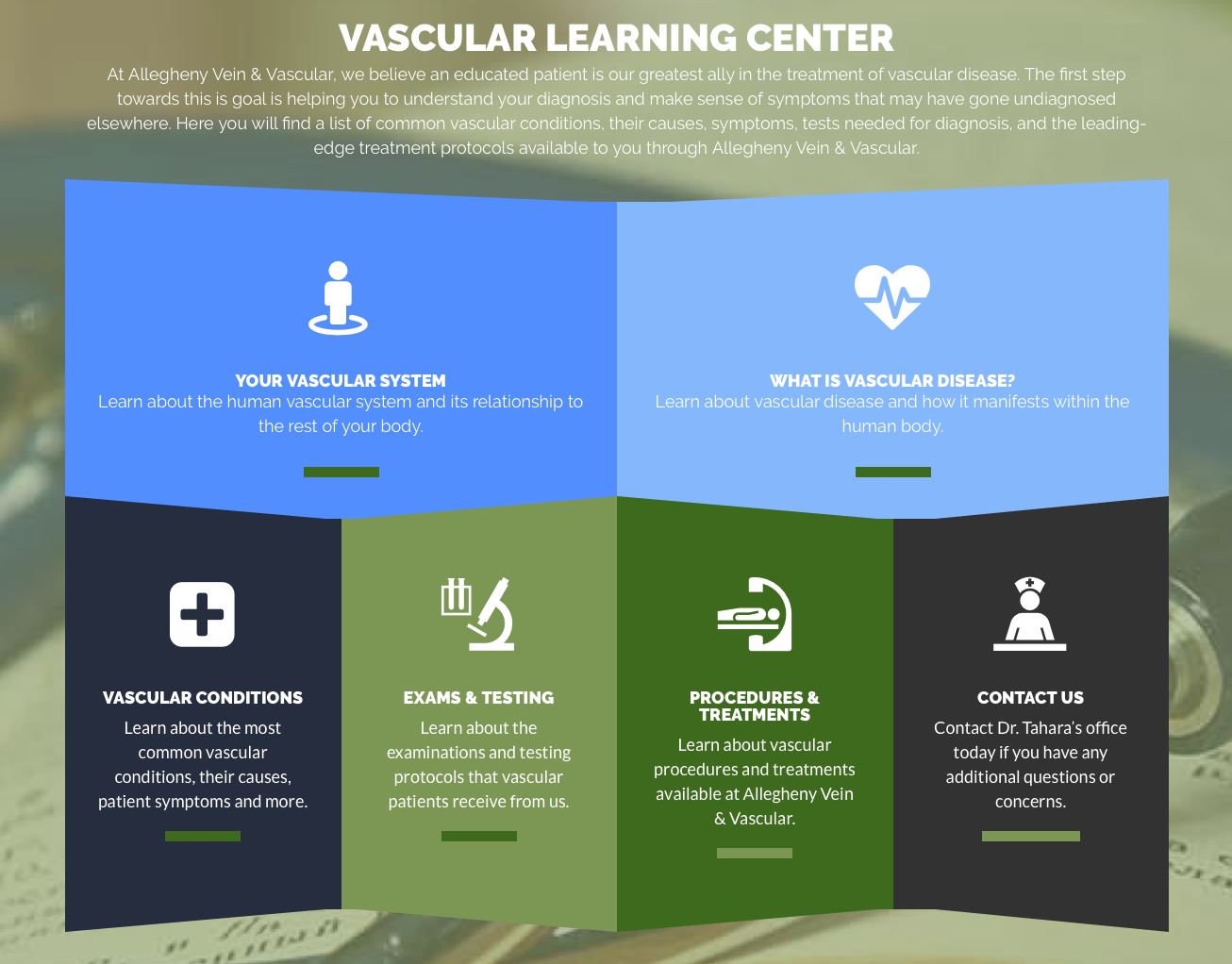
ALL THINGS VASCULAR

A great place to learn about all things vascular.

Take time to learn about the vascular system and how it functions.

Learn about venous and arterial vascular conditions that affect the body.

Explore treatments & procedures offered through Allegheny Vein & Vascular.

Learn about the examinations and testing protocols vascular patients receive.