
Venous Angioplasty for Post Thrombotic Syndrome

Learn about Venous Angioplasty for Post Thrombotic Syndrome.
What is Venous Angioplasty for Post Thrombotic Syndrome?

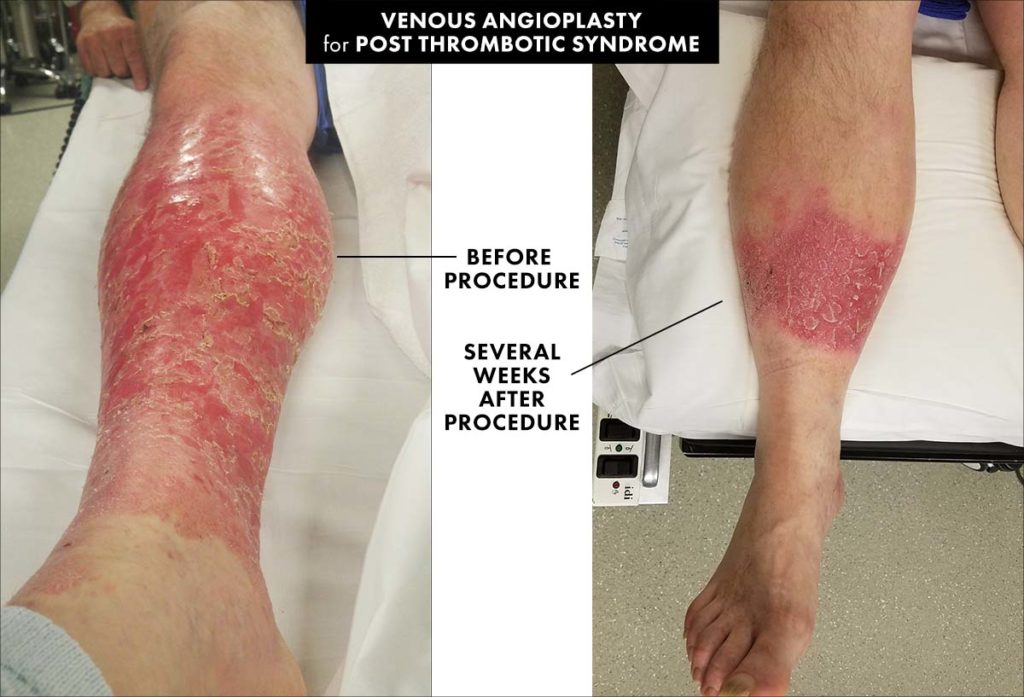
Let’s begin by first explaining that a venous angioplasty is an endovascular procedure used to specifically treat venous blockages by expanding a balloon inside the vessel at the blockage site to improve blood flow. Next, let’s explain Post Thrombotic Syndrome (PTS). PTS is a term that encompasses a wide variety of long-term complications that may occur as a consequence of another condition we call deep vein thrombosis (DVT), which usually occurs in a leg.

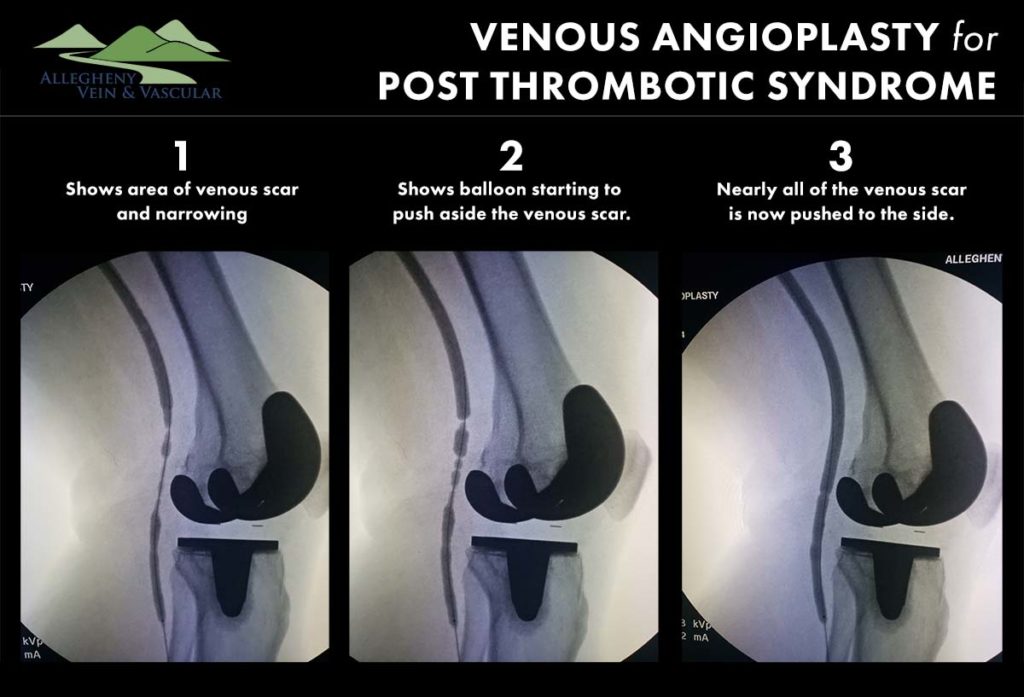
So, putting it all together, venous angioplasty for post thrombotic syndrome is an endovascular procedure that uses catheter based balloons to push aside post thrombotic changes left behind by DVT. This frequently improves the blood flow up and out of the effected leg.

Why is Venous Angioplasty for Post Thrombotic Syndrome Used?

As thrombus (clotted blood) from a Deep Vein Thrombosis (DVT) ages, the thrombus contracts and becomes a venous scar. For many people, only a little bit of scar lingers but in some people, a lot of scar remains.  This can be a serious problem because excessive scar fills the vein to the point where the blood can not properly move up and out of the leg. When the problem becomes chronic we begin to refer to it as Post Thrombotic Sydrome (PTS).

PTS symptoms include severe swelling, unremitting pain (like a deep tooth ache), and/or open ulcers at the ankle. Significant skin changes below the knee are common as well such as red, flaky (aligator skin), “weepy” skin, or brownish red and leathery skin.

Fortunately, not every person with a DVT will go on to develop a PTS condition. For those who do, though, it can significantly effect their quality of life. Venous angioplasty is still a fairly new option, with a limited number of facilities currently offering this procedure. However, for the right patient it may be an option worth considering.

How is a Venous Angioplasty for Post Thrombotic Syndrome Performed?

At Allegheny Vein & Vascular, Venous Angioplasty for Post Thrombotic Syndrome is a commonly performed procedure. For patient safely, this is a sterile procedure. At AVV, we use ultrasound guidance to access a small vein at the ankle. Venography is performed using contrast, which shows us both flow patterns and narrowings inside the deep veins that run inside the leg. A catheter-based balloon is then inserted through the ankle access point and carefully positioned where the constrictive venous scar is located. Multiple balloon inflations are required to push aside as much of the venous scar as possible. After the balloon is removed, venography is performed again to assess the changes to the venous blood flow patterns. When finished, a tiny stitch is placed at the access site and pressure is applied to control bleeding.

At Allegheny Vein & Vascular, we’ve found that every patient is different and some will require 2 or 3 of these procedures over time to attain the desired result.

The procedure usually lasts less than an hour from access to closure. Total time may be 3-4 hours.
PRIOR TO YOUR PROCEDURE

Venous Angioplasty for Post Thrombotic Syndrome can be performed in an outpatient setting like Allegheny Vein and Vascular. Dr. Tahara will provide you with detailed instructions about how to prepare for the procedure during your evaluation. Dr. Tahara carefully explores your medical history during pre-op evaluation, including recent illnesses, existing medical conditions, and any allergies you have or medications you’re taking. He will also carefully explain how you should manage your regular medications, food, and drink just prior to the procedure. As a typical example, you may be told not to eat or drink anything several hours before arrival. You may also be asked to wear loose and comfortable clothing and refrain from wearing jewelry.

WHAT TO EXPECT AFTER YOUR PROCEDURE

The Allegheny Vein and Vascular nursing staff will call you about 24 hours after your procedure to check up on you. Typically, the patient will also come in for a followup visit with Dr. Tahara about a week after the procedure is completed.  From there on out, you will be scheduled for office visits and duplex ultrasound appointments as necessary.

IMPORTANT: It is vital that patients keep their followup appointments.  The reason for this is that vascular disease is not something that just goes away.  It is a process that continues, even after any necessary procedures have been performed.  Regular monitoring of your condition will be required in order to help you realize your best possible outcome for the long term.
ALL THINGS VASCULAR

A great place to learn about all things vascular.

Take time to learn about the vascular system and how it functions.

Learn about venous and arterial vascular conditions that affect the body.

Explore treatments & procedures offered through Allegheny Vein & Vascular.

Learn about the examinations and testing protocols vascular patients receive.