
Venous Ulcer Wound Care
Non-healing foot wounds can be very serious. Learn what to do and not do if you have one.
About Venous Ulcers
Caring for Venous Ulcers
Often, a slimy, bacteria-laden coating forms on the surface of the ulcer. This is called biofilm, and if you have experienced venous ulcers you are already familiar with it! One of the most common biofilms we all experience is that tacky coating on our teeth called plaque. Much like dental plaque, if biofilm isn’t removed daily from the surface of a venous ulcer it can cause the wound to tunnel deeper into the tissue below. Unfortunately, if this happens it can lead to far more severe venous ulcers and even require an amputation to save the remaining limb and possibly the patient’s life.
After washing your venous ulcer, pat it dry and do not apply any creams, ointments, or lotions unless otherwise directed by your physician or wound care specialist. Managing drainage of the ulcer can be challenging. Unless otherwise directed by your wound care practitioner, we usually recommend a dry, sterile dressing like gauze or a Telfa (non-adherent) pad, but for large amounts of drainage that may not be enough. Many of our patients cover the initial dressing with a layer of a thicker dry sterile dressing like an ABD pad (also known as an abdominal pad). Most of our venous ulcer patients also see a wound care specialist, and we will work together to heal your venous ulcers.
Compression Stockings for Venous Ulcer Care
The liner sock is compressive but stretchy and easy to put on. It stretches to fit over the dressings applied to the ulcers, and a few pairs are prescribed so that they may be frequently changed if soiled.
The leg piece consists of a graduated column of stretchy straps that are secured with velcro and can be applied by most patients with reduced hand strength. It is very important to wear the liner sock with the leg piece for best results.
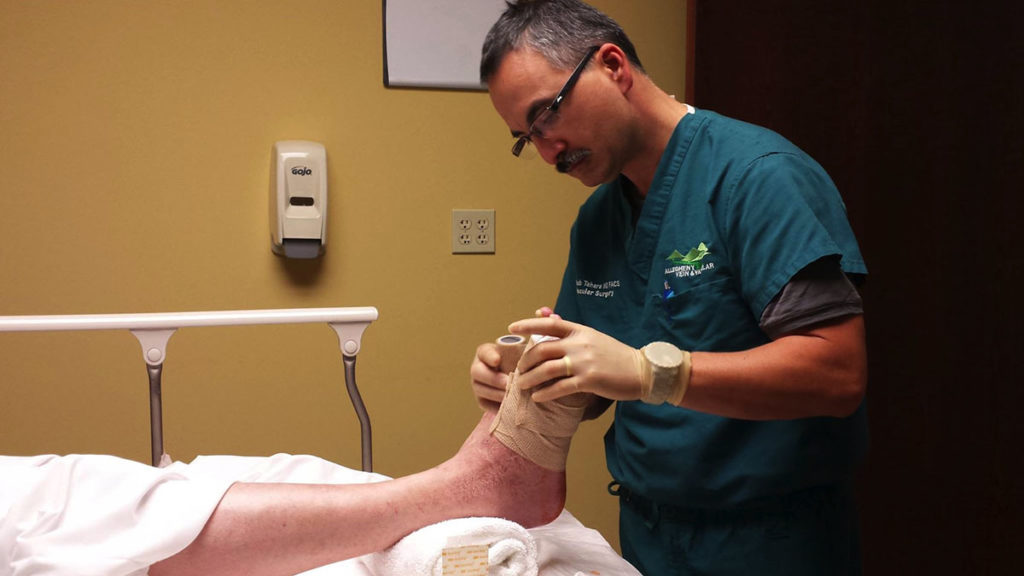
Patients with marked swelling or ulcerations on the top of their foot will also be prescribed the Farrow foot piece. This simply wraps over the foot and also has a velcro closure. While you wait for your Farrow Wrap order, Dr. Tahara will likely prescribe an ACE bandage-type wrap, called a herringbone wrap, for your leg so you can start compression. Our nurses will instruct you and a family member or caregiver in how to apply these so that you can wear them until your Farrow Wraps arrive. Unless otherwise instructed, compression is to be worn from when you wake up in the morning until just before bed.
NOTE: There are times when simple compression might not be enough, such as in cases where primary or secondary lymphedema complicates your venous insufficiency. In these cases, Dr. Tahara may prescribe a sequential compression pump device, such as the Tactile pump. This is a treatment that actively compresses from the foot to the abdomen, slowly up the leg in a repetitive cycle over the duration of the treatment. Our patients usually use this for about an hour once or twice per day.
Some Patients Require Treatment in Addition to Compression
In rare cases, a venous ulcer will require a graft to promote healthy tissue growth and healing. This is either coordinated with your wound care specialist or done in the office as a simple procedure. Dr. Tahara generally uses bioengineered skin substitute grafts in these cases, such as Apligraf.
Caring for Venous Ulcers After Treatment
Many people believe that once the ulcerations are healed that compression is no longer required, but uncontrolled venous insufficiency is the only reason why venous ulcerations start in the first place!